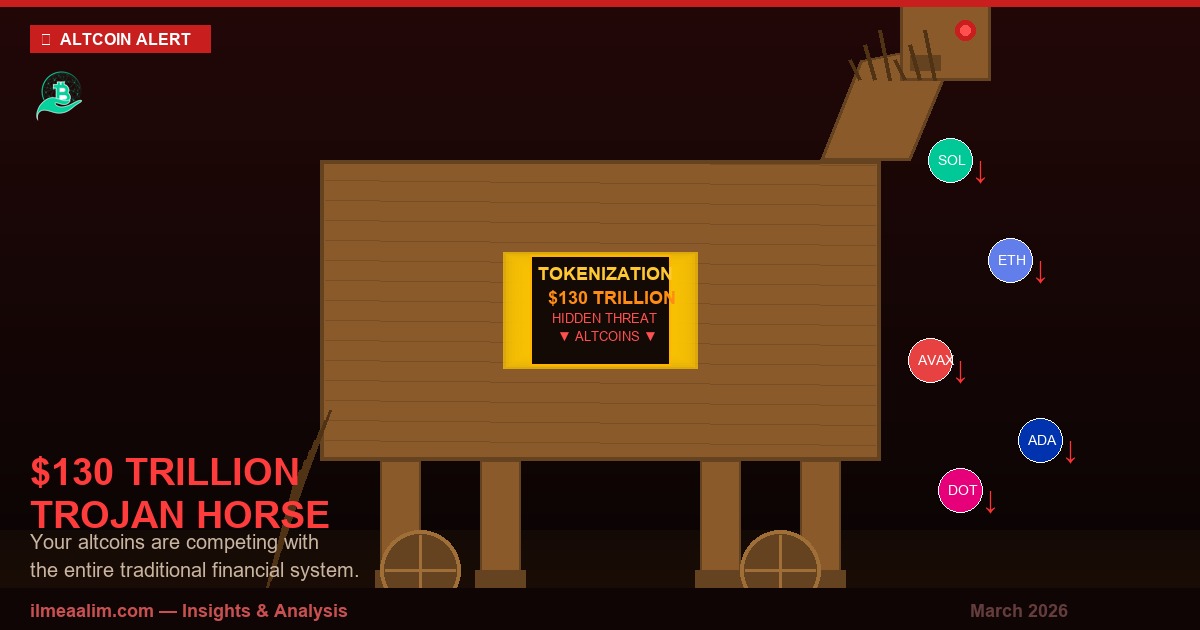
There is a story from ancient Troy that every crypto investor should read right now. The Greeks could not breach the city walls for ten years. So they built a beautiful wooden horse, left it as a gift, and hid their soldiers inside. The Trojans celebrated. They wheeled the horse through the gates themselves. By morning, Troy was burning.
Tokenization of real-world assets is that horse. And most altcoin holders are the Trojans.
The Scale of What Is Coming
The United States stock market alone is worth $69 trillion. Add global equities, bonds, real estate, and commodities, and you are looking at over $130 trillion in traditional assets. The entire cryptocurrency market is worth roughly $2 trillion. Now imagine that $130 trillion — or even 5% of it — becoming accessible on the same blockchain infrastructure where your altcoins live.
That is not a hypothetical. It is already happening. As of March 2026, over $1 billion in tokenized stocks are live onchain. Ondo Finance holds $588 million across 202 tokenized assets. xStocks (backed by Kraken) holds $238 million across 75 assets. Hyperliquid has opened permissionless synthetic markets for any stock, commodity, or index. Robinhood has listed 1,550 tokenized assets. The horse is already inside the gates.
Why Your Altcoin Holdings Are Directly at Risk
The threat is not that tokenized stocks will "replace" your altcoins. The threat is capital competition. Every dollar sitting in a speculative altcoin is a dollar that could be deployed elsewhere. Before tokenization, "elsewhere" meant Bitcoin, stablecoins, or other altcoins. The crypto ecosystem competed only with itself for capital.
That era is over.
Today, a DeFi wallet holder can keep their assets onchain and still buy tokenized NVIDIA stock (up 170% in 2024), earn 4.5% risk-free yield from tokenized US Treasury bills, or get exposure to gold — all without touching a traditional brokerage. Altcoins now compete directly with the S&P 500, Magnificent Seven tech stocks, government bonds, and commodities for the same pool of onchain capital.
The math is ruthless. If tokenized NVIDIA returns 50% in a year and your mid-cap altcoin returns 20% with ten times the volatility, the rational capital allocation is obvious. The era when any altcoin could "moon" simply because there was nowhere else to put onchain capital is quietly, permanently ending.
Who Gets Hurt Most — And Who Survives
Not all altcoins face equal risk. Here is a concrete breakdown of where specific coins stand.
🔴 Most at Risk — High Danger
These are altcoins whose only investment thesis is price speculation. With tokenized yield-generating assets now available onchain, the case for holding them deteriorates fast.
- Shiba Inu (SHIB) & Dogecoin (DOGE) — Pure meme value, zero yield, zero utility. When investors can earn 4.5% risk-free onchain, holding a memecoin with negative real returns becomes very hard to justify rationally.
- PEPE, WIF, BONK and the broader memecoin sector — Same logic as above, but with even thinner communities and no brand recognition beyond crypto circles.
- Internet Computer (ICP) — Once valued at over $700, now a fraction of that. Has real technology but has never demonstrated product-market fit. Competing for capital against RWA yields with no compelling narrative is extremely difficult.
- Algorand (ALGO) — Technically sound blockchain that has struggled to attract developers and users despite years of effort. Without a thriving ecosystem or RWA positioning, it faces serious capital flight as investors find better yield elsewhere.
- Most "Layer-1 of the month" chains — Dozens of EVM-compatible L1s launched purely to capture developer activity that never came. These have the highest risk of going to near-zero as capital consolidates around chains with actual usage.
🟡 Moderately at Risk — Watch Carefully
These altcoins have real technology and genuine user bases, but their use cases do not directly benefit from the tokenization wave. They may underperform as capital gravitates toward RWA-focused assets, but they are unlikely to disappear entirely.
- Solana (SOL) — Strong ecosystem, genuine DeFi and NFT activity. But Solana's growth story is increasingly speculative, and it competes for the same "high-beta" capital that tokenized NVIDIA can now capture. Watch whether Solana attracts serious RWA builders — if it does, it moves to the protected column.
- Avalanche (AVAX) — Has made real efforts in the RWA space (partnered with JP Morgan's Onyx platform), but its broader ecosystem remains thin relative to its valuation. The RWA positioning is a strength but not yet decisive.
- Cardano (ADA) — Years of development, real academic credibility, but persistently slow adoption. ADA investors hold on the promise of future utility. That promise becomes harder to sustain when real yield is already available onchain today.
- Polkadot (DOT) — Interoperability plays have genuine long-term value but have consistently underperformed market expectations. DOT needs a clear RWA narrative to avoid continued capital erosion.
- Cosmos (ATOM) — The "internet of blockchains" thesis is real, but ATOM the token captures less value than the ecosystem warrants. Moderately at risk from capital flight to more direct RWA exposure plays.
🟢 Relatively Protected — Stronger Position
- Bitcoin (BTC) — Has cemented itself as a macro asset that institutional investors understand independently of the altcoin market. Tokenization does not threaten Bitcoin — it may even strengthen it as a reserve asset within tokenized portfolios.
- Ethereum (ETH) — The infrastructure layer for most tokenization activity. Ondo Finance, Centrifuge, Backed Finance — nearly all major RWA protocols run on Ethereum. ETH is the gas that powers the tokenization economy.
- Chainlink (LINK) — Every tokenized asset needs reliable price feeds. Chainlink is already integrated with the SWIFT banking network, Ondo Finance, and dozens of institutional pilots. It is infrastructure, not speculation.
- XRP (Ripple) — Ripple has spent years building cross-border payment rails with banks and financial institutions. Its On-Demand Liquidity product and the XRPL's native DEX give XRP a specific, defensible role in tokenized asset settlement.
The Altcoins That Could Actually Win From Tokenization
A narrow group of altcoins are not victims of this shift — they are its infrastructure. If even a fraction of the $130 trillion flows onchain, these protocols stand to capture enormous value.
Chainlink (LINK) is the most critical piece of infrastructure in the entire tokenization stack. Every tokenized asset needs reliable, tamper-proof price feeds connecting it to real-world data. Without Chainlink, tokenized assets cannot function. LINK is not a bet on tokenization — it is the rails the entire industry runs on.
Ondo Finance (ONDO) is the governance token of the largest tokenized securities protocol in existence, with $588 million in assets and growing. As Ondo expands from tokenized stocks into bonds, real estate, and private equity, ONDO holders benefit directly from protocol growth.
Centrifuge (CFG) pioneered the model of bringing real-world credit onchain — tokenizing invoices, mortgages, and trade receivables. Already integrated with MakerDAO and Aave, giving it access to billions in DeFi capital. As appetite for onchain yield grows, Centrifuge's model becomes more valuable, not less.
Polymesh (POLYX) was built specifically for regulated security tokens — with on-chain identity verification, permissioned transfers, and built-in compliance. It solves regulatory problems that general-purpose chains like Ethereum and Solana were simply not designed to handle.
A Warning About Mantra (OM) — Why We Removed It From This List
In earlier versions of this analysis, we included Mantra (OM) as an RWA-focused chain worth watching. We are removing it from that recommendation, and here is why.
In April 2025, Mantra's OM token collapsed by over 90% in a single day — one of the most dramatic single-day crashes in crypto history for a top-20 coin. The price went from approximately $6 to under $0.50 in hours. What happened?
The root cause was a combination of extreme token centralization and alleged insider selling. On-chain analysis revealed that a small number of wallets — many linked to the Mantra team and early investors — held a disproportionate share of the total supply. These tokens had allegedly been used as collateral for large loans. When lenders issued margin calls, those positions were force-liquidated in thin market conditions, triggering a cascade that wiped out retail holders who had no warning.
Compounding the damage, the Mantra team's communication during and after the crash was poor. Explanations were vague, blame was deflected toward exchanges, and the community never received a satisfactory account of who sold, how much, and why. The DAMAC real estate partnership and other institutional deals that had driven OM's rise suddenly looked like marketing narratives used to inflate a token with centralized, exploitable supply.
Recovery has been minimal. Trust, once broken at this scale — where retail investors watched a top-20 coin lose 90% overnight — is exceptionally difficult to rebuild. While Mantra continues to operate as a blockchain and has attracted some institutional tokenization activity, the OM token itself carries a permanent stigma. The community that was burned has largely moved on, and new capital is reluctant to enter a project with such recent and severe credibility damage.
Our verdict: Mantra's blockchain technology has genuine merit for institutional RWA use cases. But the OM token's investment thesis is severely compromised. If you are evaluating RWA exposure, there are cleaner, more transparent options. At minimum, any position in OM should be treated as extremely high-risk speculation, not a strategic RWA play.
What You Should Do Now
This is not a call to panic-sell every altcoin you own. It is a call to audit your portfolio with one honest question: does this token have a compelling reason to exist in a world where tokenized NVIDIA, tokenized Treasury bills, and tokenized gold are all available onchain?
If the answer is no — if the only thesis is "the price might go up" — that thesis just became significantly weaker. The capital that used to flow into speculative altcoins because there was nowhere else to put onchain money now has better places to go.
If you want genuine exposure to the tokenization wave, focus on the infrastructure plays: LINK for oracle infrastructure, ONDO for tokenized securities, CFG for onchain real-world credit, POLYX for compliance-grade security tokens. These are not guaranteed winners — crypto is crypto — but they are the altcoins whose use cases grow stronger, not weaker, as the tokenization wave expands.
The Trojan horse is inside the gates. The question is whether you are celebrating its arrival or positioning yourself to profit from what comes next.
This article is for educational purposes only. Nothing here constitutes financial advice. Always conduct your own research before making any investment decisions.